THE INVERSION OF DESIGN ORDER
- Year: 2022
- Plataform: Archdaily Brazil
- Photo: ©RUÍNA / ©Lauro Rocha
Interview for Archdaily Portal: The Inversion of Design Order through Material Recycling - An Interview with RUÍNA
Victor Delaqua (ArchDaily): How do you perceive demolition waste within the context of "the future of construction materials"?
RUÍNA: In contemporary architectural practice, demolition plays a predominant role. Even the act of construction today presupposes a model based on the deconstruction of a place: the intensive exploitation of various natural resources with predatory extraction processes; the underutilization of materials and constructions – often, the lifespan of buildings and their materials is considerably shorter than their actual usefulness; and finally, an ecologically irresponsible disposal, as if the millions of tons of waste generated daily would simply disappear at some point, which we know will not happen. This linear production system has proven to be fundamentally flawed, harmful, and already poses a latent threat to the planet's survival. Therefore, it is undoubtedly crucial for the field of architecture to assimilate demolition as an urgently relevant activity for the mobilization of new ideas and propositions attuned to the current times and the most pressing demands of our ecosystems.
The defining feature of urban contexts is the hegemony of spaces built by human society – particularly the society conditioned by Western worldviews. In this specific type of space, demolition is inseparable from architecture, as it is the action without which architecture could not even exist as a practice. Within a circularity-promoting logic of productive systems, these "resources" would already be available within the city itself, in this "urban mine," on a daily basis. In this sense, as a "resource" for the development of new material technologies, RUÍNA believes that demolition waste holds unprecedented potential for increasingly circular production processes, more stimulating creative processes, with social responsibility and in harmony with the sustainability of the planet.
Victor Delaqua (ArchDaily): Could you elaborate on the relationship between costs, experimentation time, and the prototyping process with demolition materials during construction until defining the most suitable technical and aesthetic solutions?
RUÍNA: The immediate reuse of demolition waste in projects reduces costs related to 1) materials (the reduction varies depending on the type of application and quantities) and 2) waste disposal management (especially dumpster rental costs). Some demands that reuse may require on-site include space for material storage and possibly the use of specific equipment to optimize processes – which comes with a cost.
Reuse is a common practice in large-scale projects, primarily due to the economic scale involved, rather than ecological considerations. This is because large projects involve a significant quantity of materials and workers, along with access to machinery. In contrast, small and medium-sized projects often contribute the most to construction and demolition waste in cities, with little to no reuse. There is a lack of information and engagement for material reuse in smaller projects: projects using material reuse and recycling are often stigmatized for a certain aesthetic (of precariousness) or even suggesting that their cost should be significantly lower than conventional projects. However, in the end, as with any project, it all comes down to context, and there are no predetermined rules. One thing is certain: depending on the conditions, there is potential for significantly lower costs, and the aesthetic resources to achieve the desired outcome are diverse.
The process of experimentation and prototyping is essential to finding the best solutions and understanding the practical limits of reuse. Some processes can be conceived and executed before the construction context, while others cannot. This necessarily means that the project does not end with the design: it should function as an open process for adjustments, modifications, and even new solutions during the execution. It is necessary to abandon a linear (and authoritarian) procedural logic and embrace a circular movement that promotes autonomy. In this movement, at different scales, the project's time merges with the construction time and vice versa.
Victor Delaqua (ArchDaily): Reclaimed materials have a sustainable appeal and, being unique, deviate from a market logic where a massive amount of the same product is produced. Beyond cases where uniqueness is desired, how can these productions or techniques be scaled to reach a larger audience?
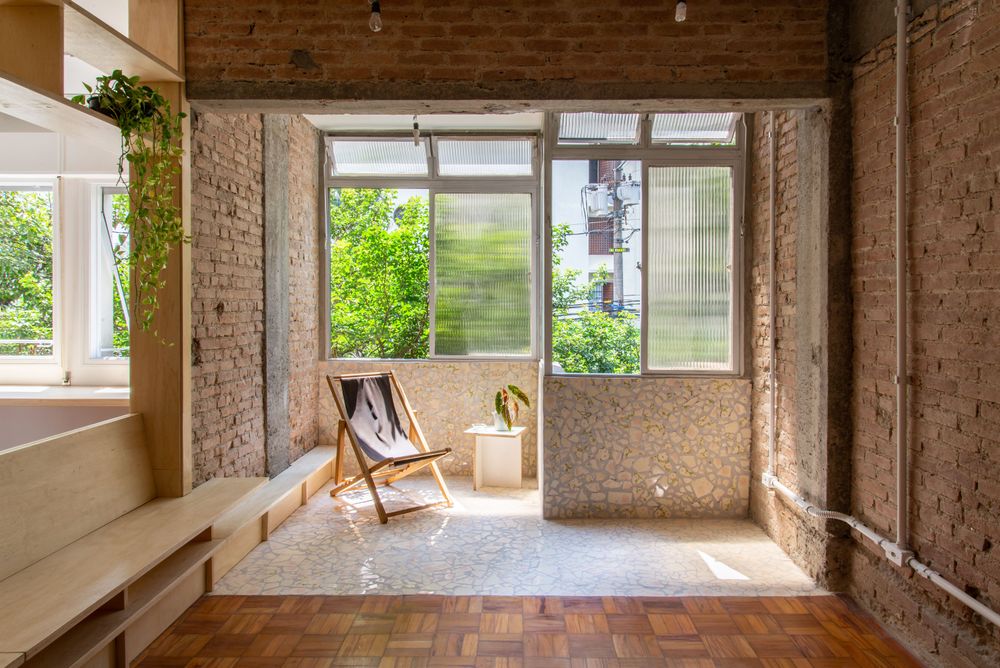
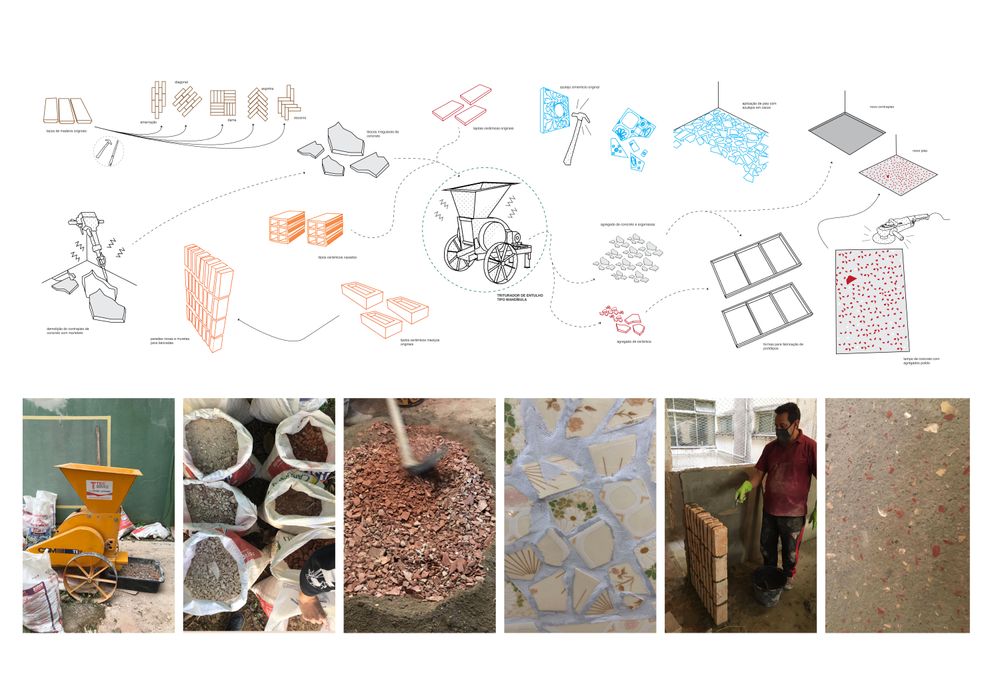
RUÍNA: One of the great contradictions of recycling is precisely its scalability in the global industry. Transporting recyclable material thousands of kilometers from the location where it will be reprocessed – to then become a reusable product – follows a logic not much different from more conventional production processes, the results of which we already know. Taking a careful look at the idea of locality, without giving up the ability to operate in a network, seems like a necessary and possible alternative. Reusing demolition materials on-site is an example of operating at the smallest local scales – the material doesn't even leave the place where it was, soon to be reintegrated into its original or distinct function (as in the renovation project for Apartamento Paraíso). Imagine the impact of change if, in every small or medium-scale renovation, consideration had to be given to the reuse of demolition and construction waste?
In Brazil, recycling and reuse in architecture are incipient in all senses. We lack regulations within the construction industry that effectively address these issues. However, initiatives like Arquivo SSA, which operates in Salvador, Bahia, with disassembly and reintegration of components for reuse in architectural projects, serve as references and pioneers in this regard. The creation of a Guide for Public Policies for the Reuse of Architectural Elements opens the way for these isolated and still limited practices to gain national scale and become part of an expanded practice.
In terms of disseminating reflections, practices, knowledge, and techniques, we believe that academia plays a fundamental role in society – without abstaining from a critical perspective, as this same academia historically reproduces classism, racism, and sexism. As an institutionalized space for the production of scientific knowledge and, therefore, a space to which power structures listen, albeit belatedly, education may be the best tool, and the university the most strategic space for these practices to reach a larger audience, as these knowledge are assimilated and introduced into public policies.
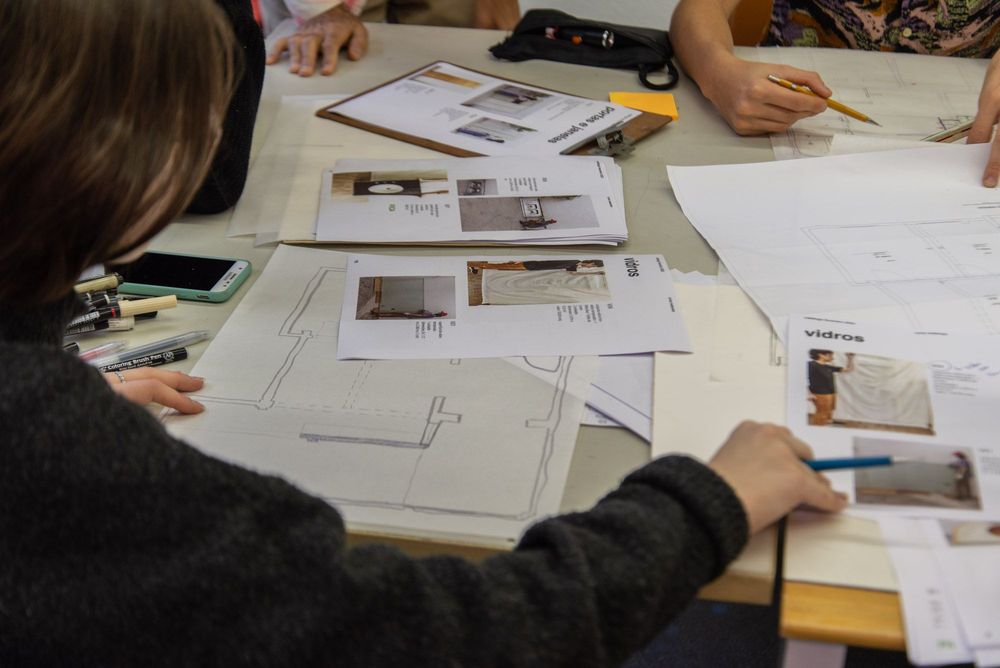
This year, RUÍNA has been building this connection between practice and academia through a course taught at FAU Mackenzie titled "(De)construct and Occupy: Reuse as a Social and Propositive Practice," in partnership with professors, students, and the Ocupação 9 de Julho/MSTC. The methodology and results of the processes developed in the course have been documented in an experiment manual with construction elements from reuse and recycling of materials.
Victor Delaqua (ArchDaily): Last year, you released a catalog of construction materials recovered from demolitions. How do you evaluate the outcome of this project today?
RUÍNA: The catalogs we produced are part of a research and action front of the office called RUÍNA Materiais. This front is dedicated specifically to the identification and cataloging of architectural elements from demolitions or disassemblies and their management for reintegration into our projects, third-party projects, or directly with users.
We evaluate the result of the catalogs as a dissemination tool and the practice of reintegration as very positive because it facilitated contact with a network of architects who work with construction and regularly encounter the amount of material conventionally discarded, raising awareness that alternatives exist and are within our reach. Some architecture offices and freelancers who sought materials cataloged by RUÍNA Materiais even assimilated this alternative design process perspective (inversion of the design order), where selected construction elements are considered for use, and the design is then adapted to them.
Victor Delaqua (ArchDaily): You approach reuse as a social and propositive practice. How do recycling issues intersect with these layers?
RUÍNA: Architecture is an applied social science. Any architectural project is necessarily social – or it should be – in the sense that it operates in the field of inhabited space for sociability, for both humans and non-humans. Understanding reuse and recycling as perspectives and practices that are part of architectural activity necessarily involves understanding its inherent social aspect.
Similar to Brazil, much of the Global South, stigmatized as "underdeveloped," experiences a reality where reuse is not just an alternative but a necessity in response to latent socio-economic limitations. The challenges affecting our country and many others are a direct product of global-scale development, not a symptom of supposed underdevelopment. Therefore, the possibility of overcoming this context lies in promoting radical changes in how we understand development. The desired destination appropriates this realization to foster new material technologies, generate autonomy in all socio-economic contexts, especially where there is a lack of access to information and means of production, highlighting that raw materials exist and can no longer depend on the extraction of natural resources from the planet. In the field of architecture, it is essential to remember that everything we have learned comes from ruins: they shape our perception, as they are our most important epistemological resources. The practice of reuse can use the concept of ruins as a tool to reclaim material and immaterial memory: thinking and acting in the present, acknowledging the past, to ensure self-awareness and a sustainable future.